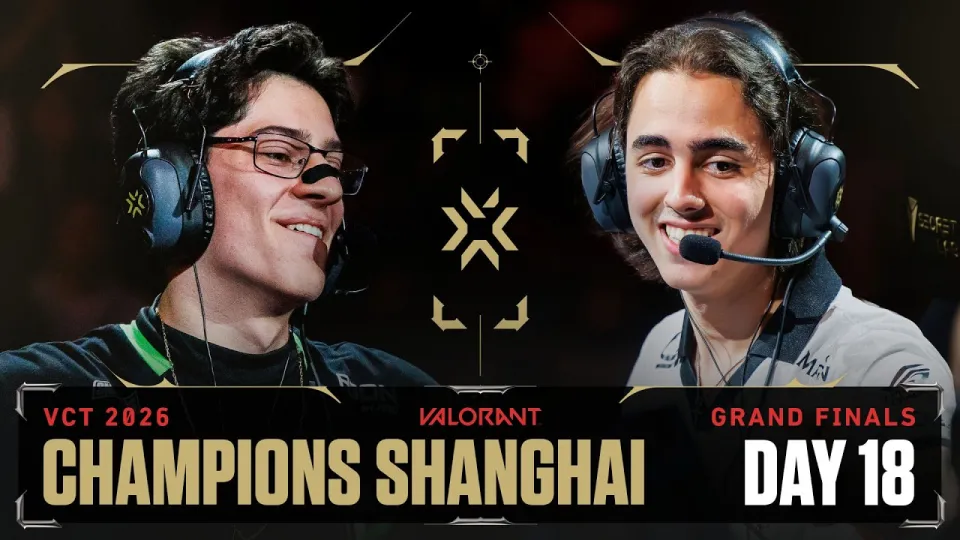
Which VALORANT Champions Shanghai grand final run was better to watch, LOUD's emotional title or Vitality's near-miss
Need articles like this for your video? They help promote it on YouTube and Google — order them in the Telegram bot @sat_sit_bot. Articles with your video embedded are written and posted by the bot itself — on popular topical sites (no ads). Free trial — 50 articles.
· based on the channel VALORANT Champions Tour
Key takeaways
- LOUD defeated Vitality in the VALORANT Champions Shanghai grand final, the closing match of a tournament running from September 24 to October 18.
- Sixteen teams from the Americas, CN, EMEA and Pacific competed for the 2026 world title in Shanghai.
- LOUD's Erde was the emotional center of the final, with viewers dedicating the win to his late mother.
- Vitality's Chronicle was the last player standing on the losing side, a detail fans called poetic.
- Masters 2026 produced two different champions before Shanghai, setting up a season where favorites kept falling.
The VALORANT Champions Shanghai grand final was the better watch of the 2026 season's closing stretch because it combined a genuinely unpredictable result with a human story that outlasted the scoreline: LOUD beat Vitality to take the world title, and the tournament's final map turned on the same kind of aggressive spawn push that decided a LOUD match on the same map back in 2022. For anyone tracking the VCT calendar, the official VALORANT Esports hub on X is where brackets, schedules and post-match updates land first.
Shanghai ran from September 24 to October 18, with sixteen teams from the Americas, CN, EMEA and Pacific fighting for the biggest trophy of the year. The bracket did not behave. Masters events earlier in 2026 crowned two different champions, and the pattern held in China: familiar names arrived as favorites and left early, while a fearless generation of challengers treated the stage like a home server.
Why the VALORANT Champions Shanghai final felt different from a normal grand final
A grand final usually sells itself on star power; this one sold itself on stakes that had nothing to do with seeding. LOUD's run was not the expected outcome even among people who watch every VCT regional, and the reaction afterward was less about a bracket prediction being right and more about a team that had been written off getting the last word. Vitality, for their part, played the final like a team that had already survived three knockout rounds and had nothing left to protect — which is exactly why the loss landed so hard.
Three things separated this series from a standard best-of-five:
- Map identity. The decisive map carried history. LOUD had won a critical match on it in 2022 with a Chamber pushing into the enemy spawn; in Shanghai, a different player made the same kind of read in the same kind of moment. Fans noticed the symmetry immediately.
- Pace over patience. Both teams opened rounds with early aggression rather than default setups, which kept the economy volatile and produced more force-buys than a typical final.
- One player carrying the emotional weight. Erde's performance became the story of the event, and the arena responded to every clutch as if it were the last round of the season.
The Erde story that turned a result into a moment
The most repeated sentiment after the trophy lift was not about utility usage or pistol-round conversion; it was about Erde's mother, and the fact that he played the biggest match of his career after a personal loss. That context reframes everything about how the final is remembered. A player who grinds through a VCT season is measured in rating and impact stats; a player who does it while grieving gets measured in something else entirely.
What stood out mechanically was that his aggression never softened. The same player who was expected to play safe and let the team's structure carry him kept taking first-contact duels and kept winning enough of them to matter. Viewers described him afterward as a giant of the server, and the phrase fits: the final was decided by someone refusing to hold back when holding back would have been understandable.
For LOUD as an organization, this is the payoff of a roster built around trusting young players in high-pressure moments rather than importing a proven closer. The Brazilian scene has produced world-class talent for years; Shanghai is the first time in this cycle that the trust was converted into the biggest trophy on the calendar.
What Vitality's loss says about the 2026 VCT season
Vitality reached the final and lost it, and that sentence undersells how close the margins were. Chronicle being the last player standing on the losing side became the image people kept sharing, because it captured the specific cruelty of a grand final: one team's celebration is filmed from the same stage where the other team is still standing.
The broader read on 2026 is that the hierarchy flattened. Two Masters events produced two different champions, and neither of them was the team that lifted the world trophy in Shanghai. That is not a fluke; it is what happens when sixteen teams from four regions all get meaningful international reps and the gap between the top eight and the top sixteen closes. For viewers, that means fewer predictable brackets. For teams, it means a group stage loss in October can no longer be dismissed as a bad day.
Vitality leave Shanghai with a runner-up finish and a roster that has now been tested at the highest level. In a season where the favorites kept falling, that experience is an asset rather than a consolation prize.
Questions viewers kept asking after the final
Was LOUD really the underdog? By seeding and by pre-event predictions, yes. By the end of the bracket, no — a team that closes out a grand final on a map with that much history is not surviving on luck.
Did the opening ceremony matter to the result? Not tactically, but it set the tone. The ceremony drew unusually strong praise, and a loud arena changes how aggressively teams are willing to take early duels.
Is this the most emotional Champions yet? For a large part of the audience, yes, and the Erde storyline is the reason. Emotional weight is not a stat, but it is why people rewatch finals months later.
What happens to the losing roster? Nothing dramatic. A runner-up finish at a world championship is a platform, not a verdict, and Vitality's core has shown it can reach a final in the most stacked field of the year.
Where to follow VALORANT esports after Shanghai
All official channels are listed below; the X account is the fastest for announcements, while Twitch and YouTube carry the rebroadcasts and full VODs.
- VALORANT Esports on X — schedules, results and announcements
- VALORANT Esports on Facebook
- VALORANT Esports on Instagram
- VALORANT Esports on TikTok
- VALORANT on Twitch
The bottom line on LOUD vs Vitality in Shanghai
LOUD's win over Vitality is the result the 2026 season needed: a final where the favorite lost, the underdog earned it, and the defining performance came from a player carrying something heavier than a bracket. The match itself was aggressive and messy in the right ways, decided on a map that already had a LOUD history attached to it. Vitality's run deserves credit rather than pity — reaching a world final in a field of sixteen across four regions is a real achievement. For the full breakdown as it aired, the VALORANT Champions Tour channel carries the complete grand final broadcast, and the official VALORANT Esports X account is the place to catch what comes next for the VCT circuit.
Questions & answers
Who won the VALORANT Champions Shanghai grand final?
LOUD won the 2026 VALORANT world championship in Shanghai, defeating Vitality in the grand final. The event ran from September 24 to October 18 and featured sixteen teams from the Americas, CN, EMEA and Pacific.
Why was Erde so important to LOUD's title run?
Erde delivered one of the standout individual performances of the tournament while dealing with the loss of his mother, and he kept playing aggressively rather than scaling back. Fans and viewers treated the trophy as a tribute to her, which turned the result into the most emotional moment of the event.
What was the historical detail fans noticed about the decisive map?
The map had already decided a major LOUD match in 2022, when a Chamber player pushed into the opponent's spawn. In Shanghai, a different LOUD player made a similar aggressive read in the same kind of situation, which viewers described as a poetic repeat of history.
Does a runner-up finish mean Vitality had a bad season?
No. Reaching a world championship final in a sixteen-team field spanning four regions is a strong result, especially in a year where two Masters events produced two different champions. Chronicle and the rest of the roster leave with high-level final experience rather than a failed campaign.
Source: LOUD vs. VIT — VALORANT Champions Shanghai — Grand Final · Markdown version