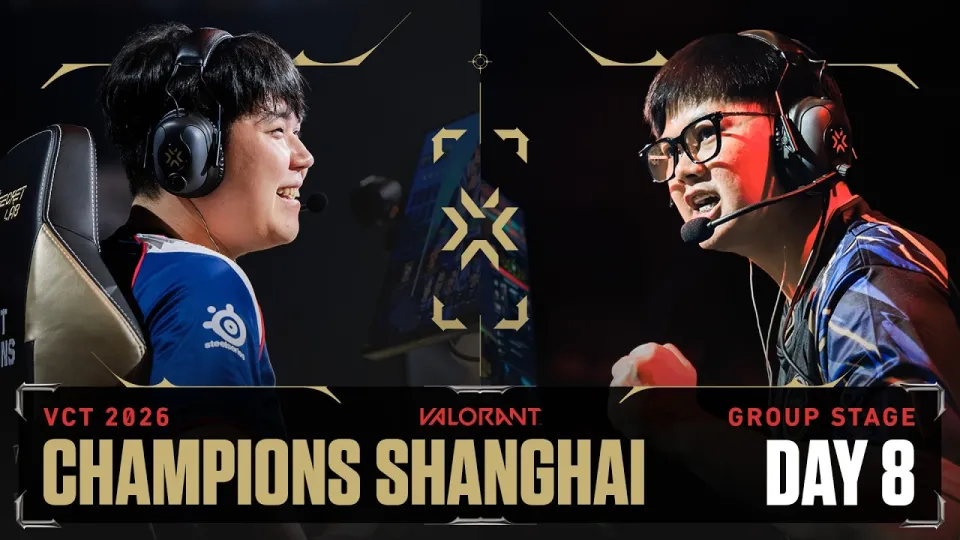
What happened on Day 8 of VALORANT Champions Shanghai group stage
Need articles like this for your video? They help promote it on YouTube and Google — order them in the Telegram bot @sat_sit_bot. Articles with your video embedded are written and posted by the bot itself — on popular topical sites (no ads). Free trial — 50 articles.
· based on the channel VALORANT Champions Tour
Key takeaways
- Day 8 of the VALORANT Champions Shanghai group stage was headlined by T1 vs JD Gaming, a three-map series that decided the last playoff spots.
- JD Gaming lost a 6-11 lead on the opening map, a comeback collapse that viewers called the turning point of the series.
- All four Chinese representatives were eliminated before the playoff bracket, despite CN hosting the event and holding direct VCT slots.
- A long technical pause interrupted the first game, and the broadcast ran past the four-hour mark across the full match day.
- Shanghai's venue drew jokes about a quiet 'library' crowd, while the Crown callout being silenced became the most-liked moment of the stream.
Day 8 of the VALORANT Champions Shanghai group stage closed out the opening phase of the 2026 world championship, with T1 vs JD Gaming deciding the final playoff picture and ending the run of the last Chinese team in the bracket. The day produced a three-map series, a blown 6-11 lead, a lengthy technical pause and a wave of debate about CN's place in the VCT ecosystem. You can follow every official update, bracket change and schedule note through the VALORANT Esports news feed on X.
What was at stake on Day 8 of the Shanghai group stage
Day 8 was the last realistic chance for the host region to keep a team alive at VALORANT Champions Shanghai. Sixteen teams from Americas, CN, EMEA and Pacific arrived in Shanghai for the September 24 to October 18 event, and by the final day of groups the CN contingent was down to its last representative.
The format is unforgiving: group stage matches are best-of-three, and only the top teams in each group advance to the playoff bracket. That means a single lost map can decide a season, and a single thrown lead can decide a career. Day 8 carried exactly that weight, which is why the T1 vs JD Gaming series became the emotional center of the broadcast.
T1 vs JD Gaming and the 6-11 collapse
JD Gaming had a genuine path to a 2-0 series win and let it slip on the opening map. Leading 6-11, they lost control of the map economy, dropped consecutive rounds on defense and allowed T1 to complete a comeback that viewers described as one of the best chances a CN team has had on the global stage.
The collapse mattered for more than one map. Losing a lead that large forces a team into a third map with damaged confidence and a shortened preparation window, and JD Gaming never recovered the tempo. The third map in particular drew criticism from the audience, who felt the team ran out of ideas once T1 adjusted.
A few recurring themes from the series:
- T1's mid-round calling stayed calm while behind, forcing JDG into low-percentage retakes.
- JDG's utility usage on attack became predictable after the first half, letting T1 stack sites.
- Individual heroics kept JDG alive in stretches, but the supporting cast could not trade consistently.
- A duelist assignment that looked unusual on paper never produced the space the team needed.
Why every Chinese team was eliminated
The most discussed storyline of the day was regional rather than individual: all four Chinese teams exited before the playoff bracket. Hosting the event did not translate into results, and the direct VCT slots handed to CN made the outcome more painful for local fans.
The counterargument that emerged in the community is that the "regional curse" is a myth. Teams from other regions have won international events on home soil, and the more honest explanation is preparation and adaptation speed. CN squads looked strong in domestic play but struggled when opponents punished default setups and forced improvisation. Hosting a global event adds pressure, media obligations and travel disruption for visiting teams, but it also adds expectation for the hosts, and that expectation visibly weighed on the group stage performances.
The Crown silence, tech pauses and other broadcast moments
Two production details dominated chat more than any round. The first was a technical pause that stretched across the opening game, long enough for viewers to joke about learning lineups during the downtime. The second was the silencing of the Crown callout, which became the most-liked moment of the stream because it removed one of the loudest recurring audio cues of the broadcast.
The venue itself drew comparisons to a library. Shanghai crowds are capable of enormous noise, but the group stage atmosphere came across as restrained on stream, and viewers noticed. That is partly a broadcast mixing issue and partly a group stage reality: weekday matches in a large arena rarely match playoff intensity.
A few clips also sparked rules debates. One round appeared to show fewer hit markers than bullets fired, and another showed a shot that many viewers expected to register as a headshot. These are the kind of moments that look conclusive in a highlight and ambiguous in a full replay, and Riot's server-side demo remains the only reliable reference.
What Day 8 means for the rest of VALORANT Champions Shanghai
The group stage result reshapes the playoff bracket. T1 advance with momentum and a proven ability to win from behind, which matters enormously in a single-elimination format where one bad half ends a tournament. Teams that cruised through groups now face opponents who have already survived a do-or-die series.
For CN, the offseason questions are bigger than one roster move. The region has the player base, the viewership and the infrastructure, but the gap at international level is currently about mid-round discipline and adaptability under pressure. Closing that gap is a coaching and scrim-culture problem, not a talent problem.
Useful links
- Official VALORANT Esports updates on X: https://x.com/valorantesports
- Facebook: https://www.facebook.com/ValorantEsports/
- Instagram: https://www.instagram.com/valorantesports/
- TikTok: https://www.tiktok.com/@valorantesports
- Twitch: https://www.twitch.tv/valorant
Final thoughts on the Shanghai group stage
Day 8 delivered the exact kind of drama a world championship group stage is supposed to produce: a favorite on the ropes, a host region watching its last hope fade, and a broadcast full of small controversies that fans will argue about for weeks. T1 leave the group stage with the most valuable currency in VALORANT, which is the belief that they can win a map they are losing. JD Gaming leave with a specific, fixable lesson about closing out leads. The full match day, including the tech pause and all three maps of the T1 vs JD Gaming series, is available on the VALORANT Champions Tour channel, whose broadcast team put together the complete Day 8 coverage. For schedule changes, bracket updates and official announcements, keep the VALORANT Esports account on X bookmarked.
Questions & answers
Did JD Gaming really have a chance to win 2-0 against T1?
Yes. JDG led 6-11 on the opening map and were in position to take the series without a third map. They lost control of the economy, dropped consecutive defensive rounds and let T1 complete the comeback, which shifted the entire momentum of the series.
Why were all Chinese teams eliminated at VALORANT Champions Shanghai?
The short answer is adaptation speed. CN teams performed well domestically but struggled when international opponents punished default setups and forced improvised mid-round decisions. Hosting the event added pressure and expectation, and the direct VCT slots made the early exit more visible.
What was the Crown silence moment everyone mentioned in chat?
During the broadcast, the Crown callout audio was muted, removing one of the loudest recurring sound cues of the stream. Viewers found it unusually satisfying, and it became the most-liked comment theme of the day.
What happens next after the group stage in Shanghai?
The surviving teams move into the playoff bracket, where the format becomes far less forgiving and a single bad half can end a tournament run. T1 enter with momentum from a reverse-sweep-style comeback, while eliminated teams head into an offseason of roster and coaching review.
Source: VALORANT Champions Shanghai — Group Stage — Day 8 · Markdown version